
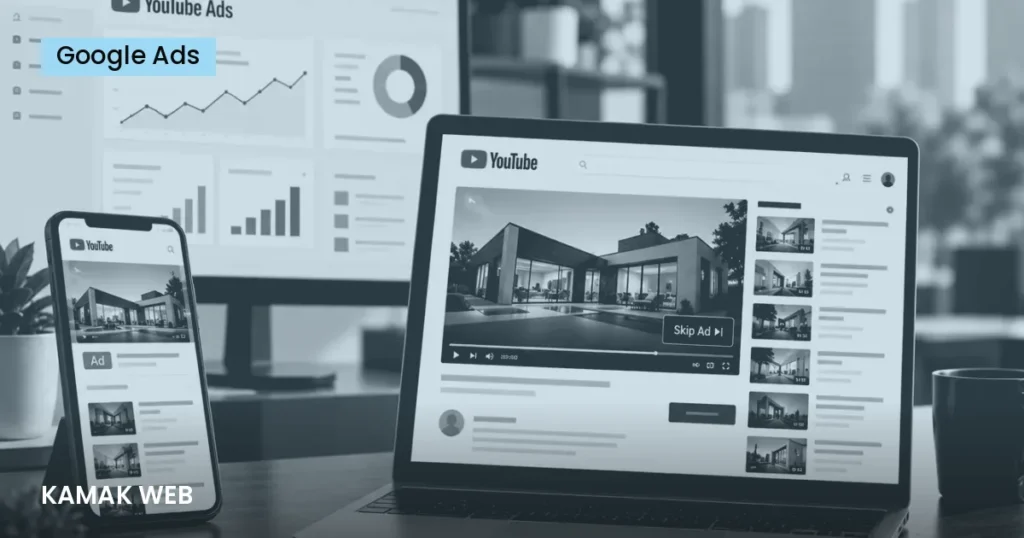
YouTube advertising is the one place where you can start with ten dollars a day and put a video in front of a local customer. It is also the place where a vague quote hides the most waste. Here is how YouTube charges, what small businesses typically pay, and what to ask before you spend.
Short version
Most agency guides put YouTube cost per view at about $0.10 to $0.30, with daily budgets of $10 to $50 for a small business. The real price depends on your industry, your audience and your video. Our management starts at $299 a month plus the ad budget you pay to Google, listed on our Google and YouTube ads page.
How YouTube charges for ads
You do not pay for every time your ad is shown. Google bills by format:
- Skippable in-stream ads: you pay when a viewer watches 30 seconds, or the whole video if it is shorter, or when they interact with it. Viewers can skip after 5 seconds, and you do not pay for a skip.
- Non-skippable in-stream ads: 60 seconds or shorter, billed per thousand impressions (CPM).
- Bumper ads: 5 to 6 seconds, also billed per thousand impressions.
- YouTube Shorts ads: a view counts at 10 seconds, or when the viewer clicks, likes, comments or shares.
- In-feed ads: billed when someone clicks to watch.
What a view usually costs
Published figures vary a lot, and almost all come from agencies, so treat them as a range, not a promise. Most 2026 guides put a typical cost per view between about $0.10 and $0.30. WebFX gives $0.11 to $0.50. Some sources quote only a few cents for broad audiences, and competitive fields such as insurance and finance cost more. Several guides say a typical small business sets a daily budget of $10 to $50.
A simple example, with numbers you should replace with your own: at $0.20 a view and $20 a day, you pay for about 100 views a day. That is views, not customers. Whether it pays back depends on what the video says and where it sends people.
What makes it cost more or less
- Competition. Many advertisers chasing the same viewers raise the price.
- Targeting. A very narrow audience, such as one city and one interest, costs more per view but wastes less.
- The first 5 seconds. People who keep watching make the campaign cheaper to run. A weak opening makes every view cost more.
- The call to action. A clear next step turns a view into a call or a visit.
Where small businesses waste money
- Targeting the whole country when you serve one area.
- Sending views to a home page with no clear action. Fix that first with a landing page built to convert.
- Counting views as results and never counting calls.
- Paying for a management fee that hides the ad budget. Ask for both numbers in writing.
What our YouTube ad management costs
Our Google and YouTube ads management starts at $299 a month, plus the ad budget that you pay directly to Google. You see the account, the spend and the calls. For the same logic on Search ads, read what you should actually pay for Google Ads management.
Frequently asked questions
How much should I spend on YouTube ads a day?
Many small businesses start between $10 and $50 a day for a few weeks, then adjust once they see calls. Start small, count results, then raise the budget.
Do I pay when someone skips my ad?
On skippable in-stream ads, no. You pay when the viewer watches 30 seconds or interacts.
Is YouTube better than streaming TV ads?
They do different jobs. YouTube reaches people searching and watching on any device, and streaming TV reaches the living room screen. See Roku advertising for local businesses to compare.
Next step
Want a YouTube plan with the budget written out? See Google and YouTube ads management or ask for a free proposal.
Further reading: Google Ads help: video ad formats and billing, WebFX: YouTube advertising cost and LocalIQ: YouTube advertising cost.